
Reading a Fragrance Quote: Development-Led vs Production-Led Costs
Two suppliers can price the same bottle and land far apart, because they are not selling the same work. A development-led partnership sells you a formula and the labour of finding it; a production-led partnership sells you a formula that already exists plus the capacity to fill it. The difference between those models is mostly in the brief, the sample rounds and the minimum order, not in the glass. Reading a quote therefore starts with one question: which model has this supplier priced me for, and does that match the brand I am actually building?
Key takeaways
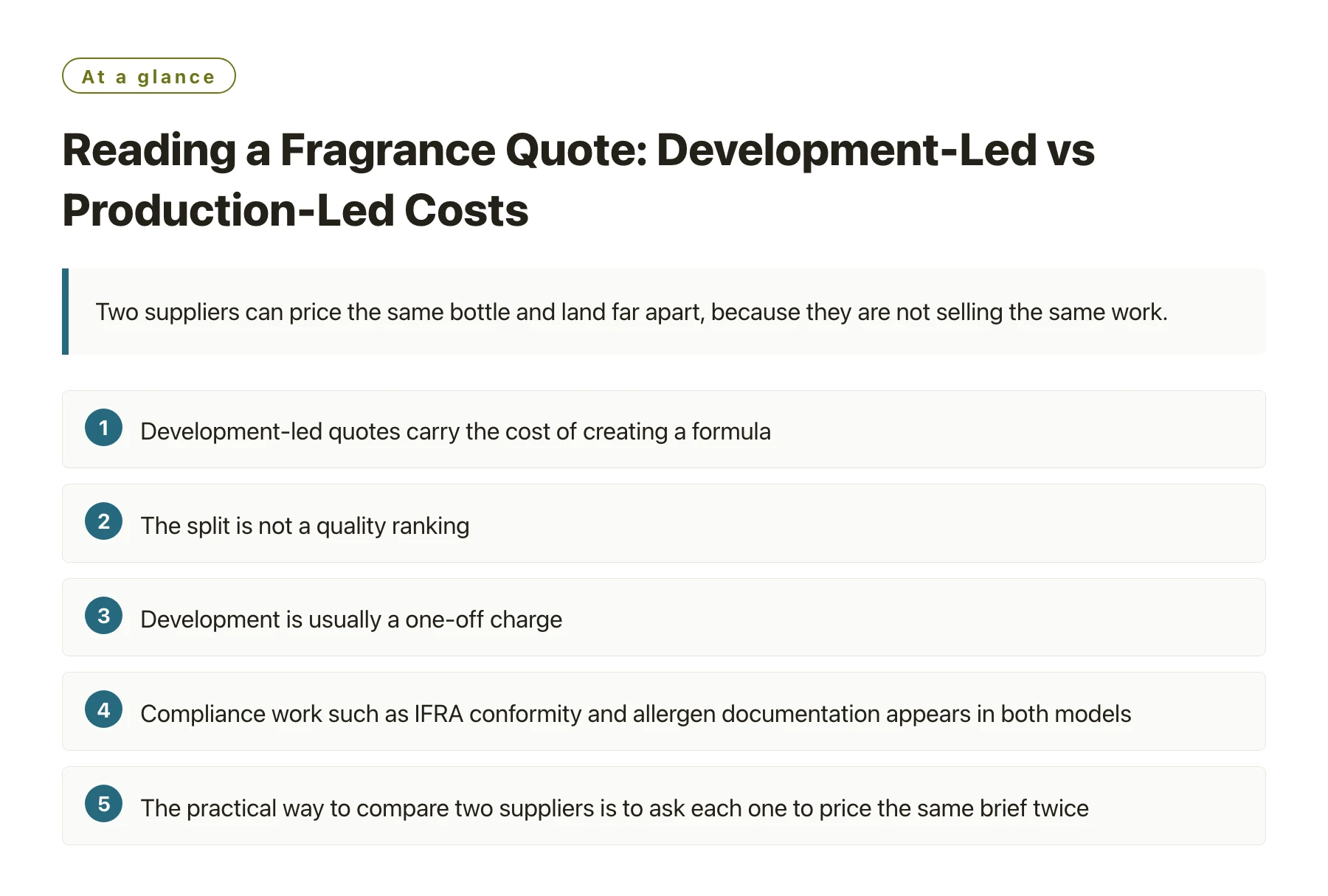
- Development-led quotes carry the cost of creating a formula, including perfumer time, brief revisions and several sample rounds; production-led quotes carry the cost of adapting something that already exists.
- The split is not a quality ranking, because a library scent can outperform a developed one when the base and the dosage are right for the product.
- Development is usually a one-off charge, so its cost per unit falls as volume rises, while production-led pricing tends to keep its margin inside the unit price at every volume.
- Compliance work such as IFRA conformity and allergen documentation appears in both models, and it is easier to price when the brief names the market and the product base [1].
- The practical way to compare two suppliers is to ask each one to price the same brief twice, once in the model they prefer and once in the other.
Most first quotes arrive as a single number per unit, sometimes with a tooling or mould charge bolted on. That format hides the most useful information in the document: how much of the price is thinking and how much is making.
It matters because the two are not interchangeable on a spreadsheet. A brand that pays for development and then orders small quantities has bought an asset with a long payback. A brand that buys a library scent at a low unit price and scales fast may never own anything it can defend. Both are rational choices; mixing them up is what causes the argument three months into a project.
This breakdown is written for an e-commerce brand, where the order pattern is usually a first run to test demand, then a reorder decided by sell-through rather than by a plan.
What each partnership model is actually selling
A development-led supplier starts from your brief. Someone interprets it, chooses materials, builds a trial compound and sends it to you for judgement. The deliverable is not only a liquid in a vial, it is a set of decisions about what the scent is made of and why. That work has a cost, and it is charged either as a development fee, as a higher first-order price, or as a commitment to buy a certain volume.
A production-led supplier starts from a catalogue. You are shown existing directions, one is chosen and adjusted at the edges, and the effort goes into matching your bottle and your dosage rather than inventing a composition. The saving is real, and so is the constraint: what you are shown is roughly what you get, and the same direction may already be on shelves under another label.
Neither approach is more professional than the other. A factory that offers both is not being indecisive; it is matching effort to the stage a brand has reached. A first run that tests a channel rarely needs a new molecule. A range that is meant to define a house usually does.
Where the boundary usually sits in practice
Most projects land somewhere between the two poles. A supplier may start from a library direction and then rewrite two or three accords, which produces something closer to a custom scent without the full development cycle. That middle path is worth asking for explicitly, because it is often priced as production work while delivering most of the differentiation a young brand needs. Finding a supplier that can hold both ends of that range is the practical goal, which is why brands increasingly look for a factory that handles fragrance R&D and production rather than splitting the two across vendors a factory that handles fragrance R&D and production.
The way to find out where you sit is to ask what happens if you reject the first submission. A development-led partner will describe a revision process with a defined number of rounds. A production-led partner will describe a re-selection, which is a different activity with a different cost.
Where the money sits in each model
| Cost line | Development-led | Production-led | What moves it |
|---|---|---|---|
| Formula creation | Perfumer time, brief revisions, several trial compounds | Selection from an existing library with light adaptation | How far your brief sits from anything the supplier already has |
| Sample rounds | Two to four rounds is typical, each with a real materials and time cost | Usually one or two rounds, because the direction is known before you see it | How precisely the brief is written and who signs it off |
| Compliance and documentation | IFRA conformity, allergen listing and safety paperwork prepared for your market | The same documents, reused across many clients and rarely rewritten | Which markets you sell into and what the retailer demands |
| Minimum order | Often lower, because development is recovered as a separate charge | Often higher, because the margin is carried inside the unit price | The packaging you choose and the supplier's line scheduling |
| Unit cost at scale | Trends toward raw material plus filling and finishing cost | Includes a margin that does not necessarily shrink with volume | Volume, bottle specification and how the compound is bought |
Neither column is cheap in the abstract. The comparison only becomes meaningful when the same brief, the same bottle and the same target market are priced in both.
The costs that never appear on the quote
Switching costs are the first invisible line. A formula built with one supplier's materials is not portable by default, and moving it means either paying to rebuild it or accepting a close match. That lock-in is not written on any quote sheet, but it is the difference between owning an asset and renting one.
Market rules are the second. Selling fragrance into the European Union brings a documentation and labelling obligation regardless of who developed the scent [2], and those obligations are cheaper to satisfy when they were considered at the brief stage rather than after the bottle artwork was approved. A quote that does not mention them is not a cheaper quote, it is an incomplete one.
Time is the third. Development adds calendar weeks that a production-led order does not need, and those weeks sit on the critical path in a way that a modest cost saving may not compensate. Reading a price sheet against the calendar is the single most useful habit in this comparison, and it is worth doing line by line rather than at the total how to compare perfume quotes.
How to read the two models off a quote sheet
- Separate the one-off from the recurringAsk which lines are payable once and which repeat on every order, then convert the one-off into a cost per unit at your realistic first-year volume.
- Ask what a rejection costsA supplier that can describe the price of an extra sample round is a supplier with a defined development process.
- Price the same brief in both modelsAsk for a production-led option even if you intend to develop, and vice versa, so you can see what the differentiation is actually worth.
- Check the specification behind the numberConcentration, bottle, carton and closure all move the unit price, so two quotes are only comparable at identical specification.
- Confirm where a premium claim landsIf the brand position depends on higher-grade materials or heavier decoration, the model that supports it is usually not the cheapest column premium fragrance production partner.
A useful test before signing anything: ask the supplier to name the three decisions in the project that would most change the price. A partner that can answer immediately has quoted you from a plan; a partner that cannot has quoted you from a template.
Sources
- IFRA Standards Library (International Fragrance Association) —— The IFRA Standards Library lists the restrictions the fragrance industry applies to individual fragrance ingredients, based on safety assessments; it is the reference point for compliant fragrance formulation.
- European Commission: Cosmetics in the EU —— The European Commission's overview of EU cosmetics rules, including the responsible person, product information file and safety report requirements.
Frequently asked questions
Is development-led always more expensive than production-led?
Not on a per-unit basis at volume. Development adds a one-off cost that can be spread over a large order, while production-led pricing keeps its margin in the unit price at every volume. On a small first run, production-led is usually cheaper in total.
Can a library scent be sold as a brand's own?
It can be sold under your label, but the scent itself is usually available to other clients of the same supplier. If the brand depends on a signature that competitors cannot copy, the exclusivity has to be negotiated separately and is priced as such.
How many sample rounds should a first order plan for?
Two rounds is a reasonable planning assumption for a well-written brief, with a third held in reserve. The number is driven by how specific the brief is, not by the supplier's competence alone.
What should a quote include besides the unit price?
Development or tooling charges, sample costs, packaging and decoration, compliance documentation, minimum order quantity and the lead time those figures assume. A quote missing the lead time cannot be compared with another quote.
Does a low unit price mean the supplier is cutting corners?
Not necessarily. It may mean the scent comes from a library, the bottle is a stock mould, or the volume is aggregated with other orders. It becomes a problem only when the low price was quoted against a specification the supplier cannot actually deliver.
Read the briefing before everyone else.
One email each Wednesday. Field reporting from Accra, market data, and the cultural threads shaping Ghana — read by 41,800 subscribers across 89 countries.